
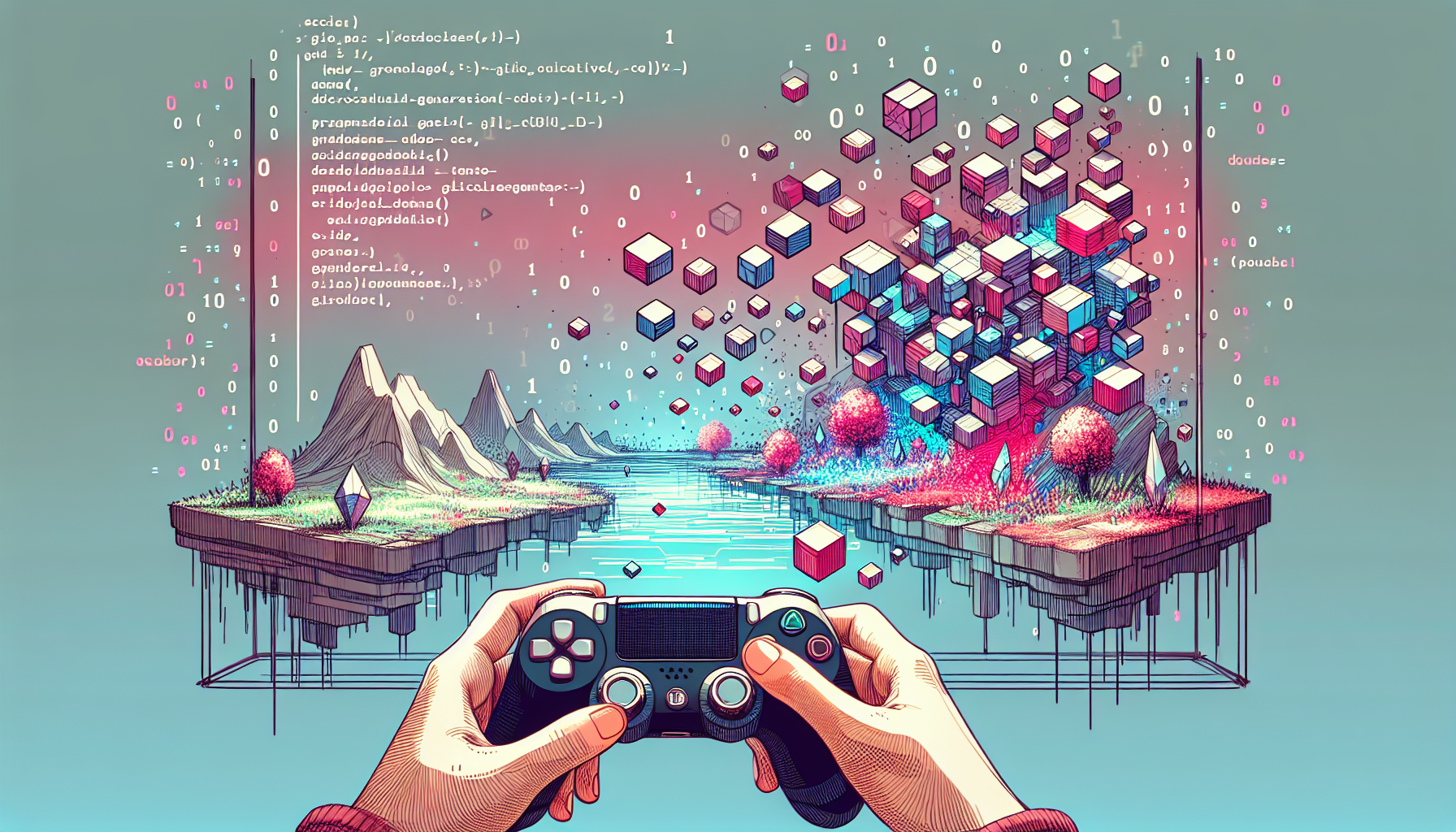
Worlds Without End: How Algorithms Secretly Build the Games You Love
Imagine stepping into a world so vast that no two players ever experience exactly the same landscape, dungeon, or storyline. Imagine forests that stretch beyond any developer’s ability to hand-craft, cities that breathe with emergent life, and caves filled with treasures no designer ever placed by hand. This is the promise — and the reality — of procedural generation, one of the most fascinating and misunderstood technologies in modern video game development.
Procedural generation is not magic, though it often feels that way. Behind every infinitely scrolling galaxy, every randomly assembled dungeon corridor, and every algorithmically grown forest lies a set of mathematical rules, clever data structures, and carefully tuned parameters. Understanding these systems doesn’t diminish their wonder — it deepens it.
What Is Procedural Generation, Really?
At its core, procedural generation refers to the creation of content through algorithms rather than through direct manual authorship. Instead of a game designer placing every tree, rock, enemy, and treasure chest by hand, a developer writes rules — a program — and lets the computer generate those elements automatically based on defined logic and mathematical functions.
The term “procedural” comes from computer science, where a procedure is simply a set of instructions. When generation is procedural, it means the content emerges from executing those instructions, often combined with a seed value — a number that initializes the algorithm and determines its output. Change the seed, and you get an entirely different world. Keep the same seed, and the world is perfectly reproducible every time.
This distinction is crucial: procedural generation is not the same as randomness. While random elements are often involved, pure chaos would produce unplayable garbage. The real art lies in constraining randomness within meaningful rules that produce coherent, enjoyable, and varied results.
The Building Blocks: Key Algorithms Powering Procedural Worlds
Noise Functions: The Foundation of Natural Worlds
If you’ve ever marveled at the rolling hills of Minecraft or the alien terrain of No Man’s Sky, you’ve witnessed noise functions at work. Perlin noise, developed by Ken Perlin in 1983, is arguably the most influential algorithm in game world generation. Unlike pure random noise (which produces a static, chaotic pattern), Perlin noise generates smooth, continuous variations that mimic natural phenomena like terrain elevation, cloud density, or moisture levels.
More modern variants, like Simplex noise (also by Perlin) and OpenSimplex noise, improve upon the original by reducing directional artifacts and improving computational efficiency. These functions operate by sampling values at multiple scales — called octaves — and layering them together. Low-frequency octaves create broad continental shapes; high-frequency octaves add fine details like rocky outcroppings and small hills.
- Perlin Noise: Smooth gradient-based noise ideal for terrain heightmaps
- Simplex Noise: Faster and less directionally biased successor to Perlin
- Worley Noise: Cell-based noise perfect for simulating biological textures, cracked earth, or cellular patterns
- Fractional Brownian Motion (fBm): Stacking multiple noise octaves to create self-similar, fractal-like detail
L-Systems: Teaching Algorithms to Grow
Developed by biologist Aristid Lindenmayer in 1968, Lindenmayer systems (L-systems) are formal grammars used to model the growth of biological organisms. In game development, they’re used to procedurally generate trees, plants, cave networks, and even entire city layouts.
An L-system works by starting with a simple axiom (like a single line segment) and repeatedly applying transformation rules. For example, a rule might say “replace every line with a branching pattern.” After several iterations, what began as a single stroke becomes a complex, realistic-looking tree. Games like Spore used L-system-inspired approaches for generating creature anatomy, while many modern games use them for vegetation.
Voronoi Diagrams: Dividing Space Intelligently
Voronoi diagrams partition a plane into regions based on distance to a set of seed points. Each region contains all points closer to its seed than to any other. This elegant mathematical structure appears throughout game development: generating territory boundaries, creating natural-looking cell structures, distributing biomes across a world map, and even helping with dungeon room placement.
When you see a strategy game’s map divided into seemingly organic political territories, or a role-playing game’s world split into distinct climate zones, there’s a good chance Voronoi diagrams (or their conceptual relatives) are involved behind the scenes.
Dungeon Generation: The Classic Procedural Challenge
Few problems in game development have inspired more algorithmic creativity than the procedural dungeon. From the pioneering ASCII crawls of Rogue (1980) to the hand-crafted-feeling levels of Hades and Dead Cells, dungeon generation represents a microcosm of the entire procedural generation challenge.
BSP Trees: Divide and Conquer
Binary Space Partitioning (BSP) trees recursively divide a rectangular space into smaller rectangles, then place rooms within those divisions and connect them with corridors. The algorithm guarantees that all rooms are reachable and that the dungeon fits within a given space. It’s predictable, reliable, and produces clean, dungeon-like layouts — which is both its strength and limitation.
Cellular Automata: The Cave Generator
Want organic, cave-like spaces instead of rectangular rooms? Cellular automata — the same family of algorithms behind Conway’s Game of Life — are your tool. The process starts with a grid of randomly filled and empty cells, then repeatedly applies a rule: a cell becomes a wall if more than a threshold number of its neighbors are walls; otherwise it becomes open space. After several iterations, smooth, organic cave networks emerge from the initial noise.
Wave Function Collapse: Constraint-Based Generation
One of the most exciting recent developments in procedural generation is the Wave Function Collapse (WFC) algorithm, inspired by quantum mechanics terminology. WFC works by observing patterns in a sample input (like a small hand-crafted tileset) and learning the rules of which tiles can legally appear next to which other tiles. It then generates new maps that follow those same adjacency constraints.
The result feels remarkably hand-crafted because it literally learns from human-designed examples. WFC has been adopted in numerous indie games and is praised for producing output that feels coherent and aesthetically consistent without requiring developers to explicitly define every rule.
Narrative and Quest Generation: Can Algorithms Tell Stories?
Procedural generation extends far beyond terrain and dungeons. Some of the most ambitious applications attempt to generate narrative content — quests, dialogue, character backstories, and emergent stories.
Dwarf Fortress, perhaps the most complex simulation ever built for entertainment, generates entire world histories, civilizations, notable figures with detailed biographies, and mythologies before you even begin playing. Its procedural history generation creates legends of wars fought centuries before your game starts, artifacts with stories attached to them, and heroes whose deeds are recorded in an in-game encyclopedia.
Wildermyth uses a modular approach, combining hand-written story fragments with procedural assembly logic to create RPG campaigns that feel authored but are unique each playthrough. This hybrid approach — sometimes called mixed-initiative design — represents the current state of the art in narrative generation.
The Seed: One Number to Rule Them All
Central to most procedural generation systems is the concept of the seed. A seed is the initial value fed into a pseudo-random number generator (PRNG). Because computers can’t generate truly random numbers, PRNGs produce sequences of numbers that appear random but are fully deterministic given the same seed.
This has profound implications for games. Minecraft‘s famous seed system means that typing “Glacier” or any other word generates the same world for every player worldwide. Communities form around sharing remarkable seeds, and speedrunners exploit known seeds to plan optimal routes. The seed transforms procedural generation from chaos into reproducible, shareable, explorable possibility.
The Design Philosophy: Constraints Make Creativity
The greatest insight in procedural generation design is counterintuitive: more constraints produce better results. An algorithm with no rules produces noise. An algorithm with thoughtful constraints produces worlds.
Game designers working with procedural systems must think differently than traditional level designers. Instead of asking “what should this level look like?”, they ask “what rules, when applied, will produce levels I’d be happy with?” This shift from direct authorship to rule authorship requires a deep understanding of what makes content fun, legible, and varied.
- Critical path guarantees: Ensuring the player can always reach the goal
- Difficulty curves: Ramping challenge appropriately through the generated content
- Aesthetic coherence: Ensuring generated content looks intentional, not arbitrary
- Surprise within expectation: Creating novelty while maintaining familiar gameplay patterns
Famous Games and Their Procedural Secrets
No Man’s Sky generates over 18 quintillion planets using layered noise functions, L-system-inspired flora, and deterministic algorithms seeded by planet coordinates. Each planet is unique, yet the underlying mathematical grammar ensures they all feel like they belong to the same universe.
Spelunky, designed by Derek Yu, uses a tile-based template system that guarantees challenge and fairness while producing enormous variety. Its approach — selecting from handcrafted room templates and assembling them with connecting logic — shows that procedural generation doesn’t require abandoning human craft.
Diablo‘s procedurally generated dungeons set the template for an entire genre. By combining random room selection with connectivity algorithms, it created replayable dungeon crawls that felt fresh across hundreds of hours — a commercial and design triumph that echoes through every modern roguelike.
The Future: Machine Learning Meets Procedural Generation
The frontier of procedural generation is increasingly intersecting with machine learning. Generative Adversarial Networks (GANs) and large language models are being explored as tools for generating game content that learns from examples rather than following explicit rules. Researchers have trained neural networks to generate playable Mario levels, coherent dungeon maps, and even meaningful dialogue trees.
However, traditional algorithmic approaches remain dominant in production game development for good reasons: they’re predictable, auditable, computationally cheap, and give designers precise control. The future likely lies in hybrid systems where ML assists human designers and augments traditional algorithms rather than replacing them.
Conclusion: The Algorithm as Co-Author
Procedural generation represents one of the most profound collaborations in creative history: a partnership between human designers and mathematical processes. The designer writes the rules; the algorithm writes the world. Neither alone could produce what they create together.
Every time you discover a breathtaking vista in a procedurally generated game, find a perfectly placed treasure in a dungeon no human designed, or lose yourself in a world larger than any team could hand-craft, you’re experiencing the culmination of decades of algorithmic artistry. The screen shows you the result. Behind it, in the silent language of mathematics, a set of elegant rules is quietly building infinity — one seed at a time.